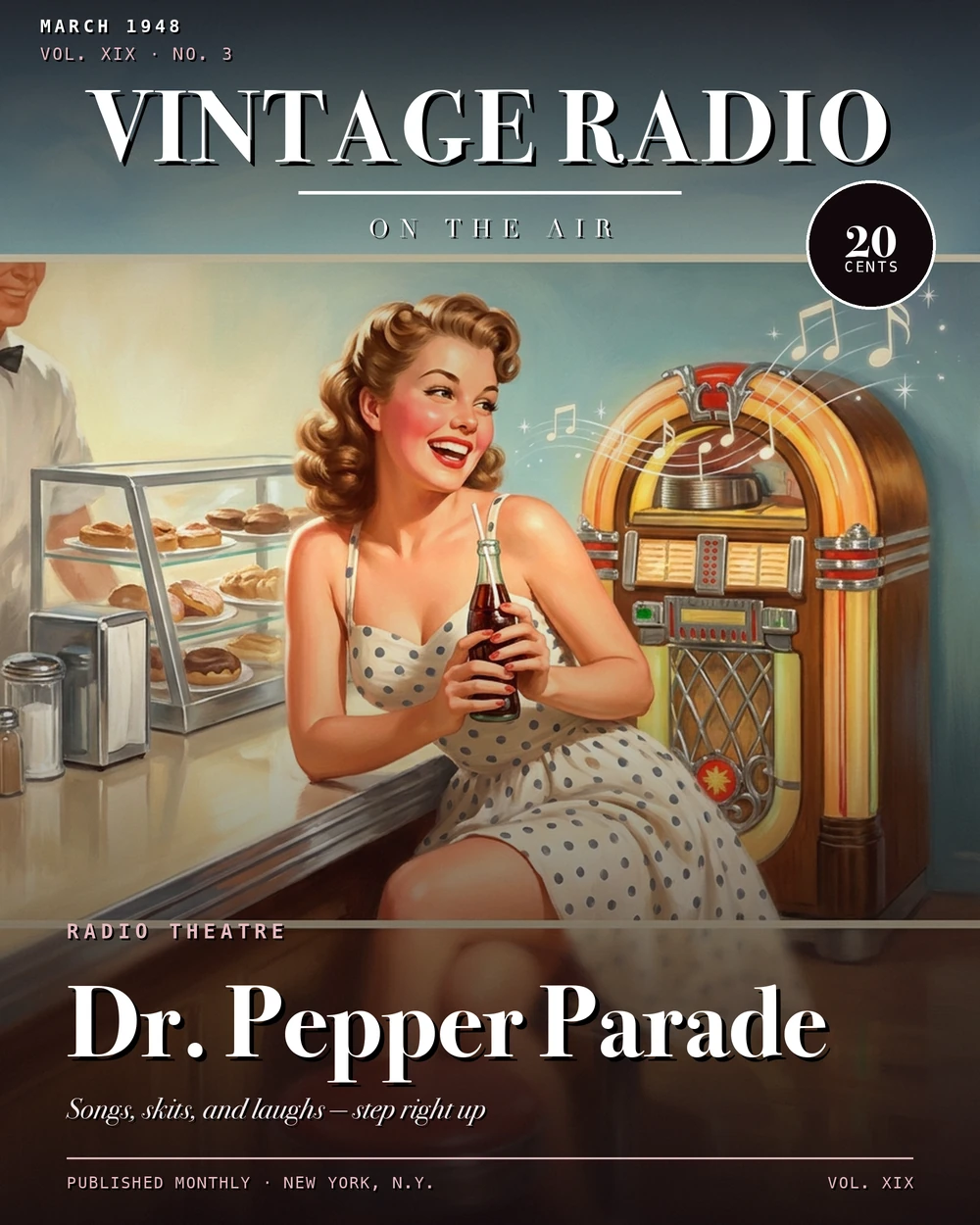
Dr. Pepper Parade
What the Show Was
Dr. Pepper Parade was a mid-1940s comedy variety program sponsored by and built around the Dr. Pepper soft drink brand. It followed a format well-established by that point in American radio: a product's name goes in the title, and the broadcast itself combines comedy skits, musical performances, and guest appearances into something that doubles as entertainment and advertising at the same time. Programs like The Pepsodent Show with Bob Hope and the Pabst Blue Ribbon Show had already proved the model worked. Dr. Pepper Parade was operating in that same tradition.
Dr. Pepper wasn't a casual radio presence in the 1940s. The company ran multiple broadcast properties simultaneously — an aggressive strategy for a regional soft drink working to compete in a crowded market. Dr. Pepper Parade was one piece of a larger radio push that included other sponsored properties, so the show existed alongside, or at various points succeeded, other Dr. Pepper efforts on the airwaves. It was never the company's only bet; it was one play in a broader hand.
Dr. Pepper's Radio Strategy in the 1940s
To understand Dr. Pepper Parade, it helps to know what the company was doing on radio more broadly. During the same mid-1940s period, Dr. Pepper was sponsoring The 10–2–4 Ranch — later retitled 10–2–4 Time — a syndicated program that aired primarily in the Southern United States and other markets where Dr. Pepper was distributed. That show featured the Sons of the Pioneers and Dick Foran, and its country-and-western flavor suited the brand's regional stronghold.
At the same time, Dr. Pepper was backing comedian Al Pearce on the Blue Network in 1944. When Pearce's run ended, the company didn't simply pull out — it held onto the sponsorship slot and redirected those dollars to an audience-participation show called Darts for Dough. That show had started locally at WFAA radio in Dallas, created by Orval Anderson and Bert Mitchell, before moving to Hollywood in August 1944 and eventually broadcasting coast-to-coast for several years. By 1950 it had moved to television. The fact that Dr. Pepper kept its sponsorship going even through a cast change says something about how seriously the company was approaching radio as an advertising platform. Their advertising in this era was described as "marked by both innovation and determination to compete in a highly competitive market sector."
Dr. Pepper Parade fits into this picture as the comedy variety entry in a portfolio of radio properties. The company was covering different formats and different audiences at the same time, and the Parade — with its skits and music and guests — was aimed at the broad, entertainment-first end of the dial.
The Format and What It Offered
The variety format that Dr. Pepper Parade used was built for accessibility. Comedy skits gave audiences something to laugh at; musical performances kept the pace moving; and guest appearances added the element of surprise — tuning in might bring someone unexpected. It was a formula designed to hold a general audience rather than appeal to a narrow niche, and it served the sponsor's interests perfectly. The wider the tent, the more potential customers were listening.
That balance between advertising and entertainment is actually what gets remarked upon when the show comes up at all. Rather than running a program that existed purely as a vehicle for product pitches, Dr. Pepper Parade apparently invested enough in the entertainment side that it held its own as a comedy variety show — one that resonated beyond its advertising purpose. That's a meaningful distinction in the 1940s landscape, where plenty of sponsor-driven programs were thin enough that the commercial was the only thing anyone remembered.
The show appeared in contemporaneous catalog listings of radio variety programs alongside recognized acts like Eddie Condon's Jazz Concert and Doris Day, which confirms it was treated as a legitimate entry in the variety field rather than as a pure promotional novelty.
What Survives
Ten episodes of Dr. Pepper Parade are held in the catalog, numbered 14, 15, 16, 17, 18, 19, 34, 36, 37, and 38. The episode numbers themselves are a small piece of evidence about the show's run — the gap between Episode 19 and Episode 34 suggests material that isn't accounted for in what has been preserved, and the presence of Episode 38 puts the show's total run at a minimum of that many installments. How long the show actually ran in full is not clearly documented; the 1940s premiere date is established, but no finale date has been pinned down.
The fact that any episodes survive at all puts Dr. Pepper Parade in better shape than a lot of its contemporaries. A significant portion of mid-1940s radio simply didn't make it through the decades. That ten numbered episodes are preserved gives at least a partial picture of what the show sounded like and how it operated.
Why It Gets Overlooked
Dr. Pepper Parade tends to get passed over in standard accounts of radio history, which is not entirely surprising. The Golden Age produced an enormous volume of programming, and shows that weren't anchored to a famous name or a long run often get buried under the more prominent titles. The show doesn't have a marquee comedian attached to it the way The Pepsodent Show had Bob Hope, and it was tied to a regional-friendly product rather than a national institution.
But the show is worth attention for a couple of reasons. It's an early and reasonably clear example of brand integration done with some craft — the kind of programming where the sponsor's presence is woven into the entertainment rather than interrupting it. And the format it used, that particular mix of comedy skits, music, and rotating guests, contributed to the shape of what came after in radio and eventually television variety programming. Shows that came later and got more credit were working in a form that earlier programs like Dr. Pepper Parade had helped develop and refine. The show may be underrepresented in the historical record, but the format it represents was genuinely influential.